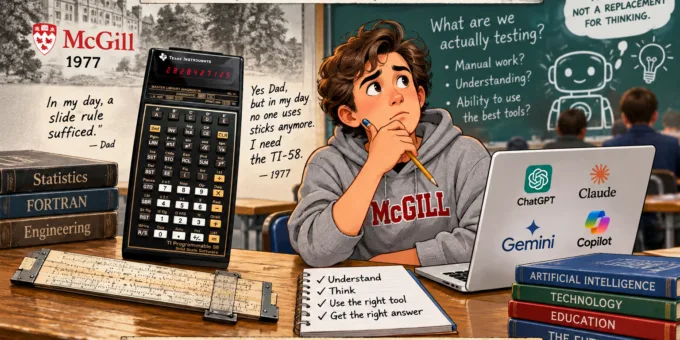
Nearly 50 years ago, a programmable calculator helped me finish a 90-minute university exam problem in minutes. Today’s debate over artificial intelligence in schools feels remarkably familiar.
Before AI, There Was the Programmable Calculator
When I was at McGill University in 1977, I took a course in Statistics and Probability.
Calculators were still relatively new. Texas Instruments and Hewlett-Packard were the two brands most students seemed to buy. TI used the more conventional algebraic method of entering calculations, while HP was famous for Reverse Polish Notation, or RPN.
Both companies were at the height of innovation. Calculators were becoming programmable, although in a very primitive way compared with the personal computers that soon followed.
This was around the time Radio Shack introduced the TRS-80 — affectionately called the “Trash-80” — with an actual processor, keyboard and screen.
Universities and professors were trying to keep up with technology that seemed to change every year.
Sound familiar?
Computing at McGill in the 1970s
At McGill, we had a massive UNIVAC computer system that occupied multiple floors.
FORTRAN was my thing.
Using a computer was nothing like opening a laptop today. You entered your program and ultimately produced punched cards containing the instructions.
You could have hundreds of cards in a program.
The cards were fed into a reader, the UNIVAC compiled and ran the program, and the results came out on a line printer.
If there was an error, you fixed the program and tried again.
There was no Google. No laptop. No smartphone.
And certainly no ChatGPT.
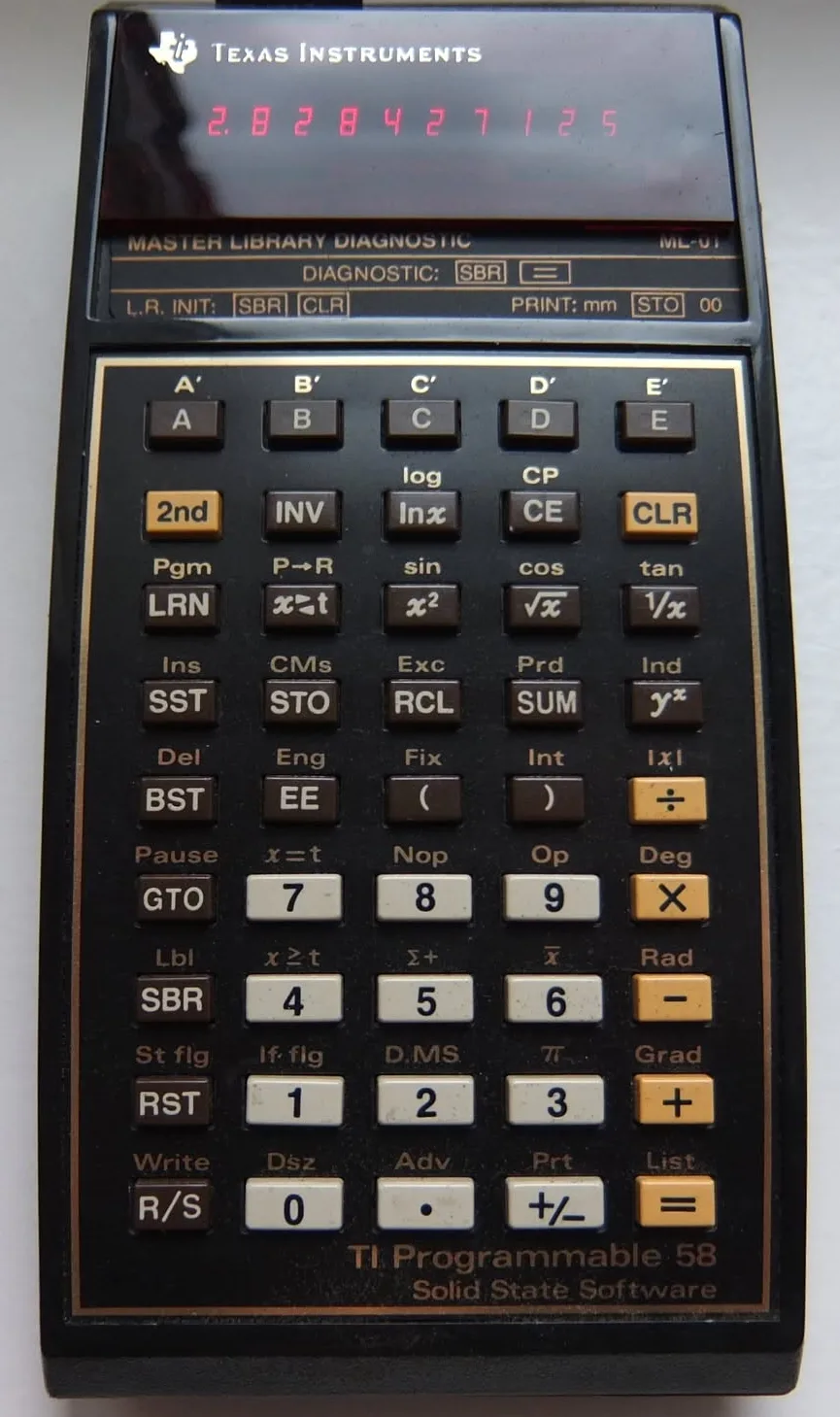
Then along came something that, to an engineering student in 1977, was pretty revolutionary: the Texas Instruments TI-58 programmable calculator.
“In My Day, a Slide Rule Sufficed”
I think I paid about $170 for my TI-58, which was a lot of money in 1977.

My father thought it was unnecessary.
He had also graduated from McGill as a civil engineer and was very proficient with a slide rule. My uncle was a professor of mathematics at McGill, and my brother and my wife also attended McGill, so there was quite a family connection to the university.
My dad told me:
“In my day, a slide rule sufficed.”
I replied:
“Yes, Dad, but in my day no one uses sticks anymore. I need the TI-58.”
He gave me the money to buy it.
Of course, it came out of my long-term allowance program of $10 a week.
I became quite proficient at programming that calculator.
I didn’t realize at the time just how useful that would become.
The Final Exam
Then came my final exam for Statistics and Probability.
For the first time, the professor announced that calculators would be allowed in the exam.
Remember, this was 1977.
Allowing calculators into an exam was a big deal. The equivalent today might be telling students they could bring their smartphones into a final exam.
The exam was essentially based on one long iterative mathematical problem.
The professor didn’t even print the problem in the examination booklet. He wrote it on the chalkboard at the beginning of the exam while referring to a piece of paper in his possession.
That way, there was virtually no possibility that anyone could have obtained the question beforehand.
The problem required repeatedly inserting numbers into an equation, calculating a result, using that result to determine the next numbers and continuing until the answer stabilized.
Think of a pendulum swinging from side to side, gradually settling in the middle.
It was tedious work with a pencil and slide rule.
A conventional calculator made it easier, but the problem was still expected to take a student around 90 minutes.
There was just one problem the professor hadn’t anticipated.
My TI-58 was programmable.
Press GO
I entered the formula into the TI-58.
Then I pressed GO.
And waited.
About five minutes later, the calculator produced the answer.
I wrote it in my examination workbook.
At approximately 9:10 a.m., I handed in my exam.
The professor looked at me.
“Is everything OK?”
“Yes.”
“Did you do the problem?”
He knew that even with a conventional calculator, the problem should have taken a normal student somewhere around an hour and a half.
I had essentially finished it in about 10 minutes.
Much of that time had been spent filling in my name, student number, course number and date while waiting for the TI-58 to finish calculating.
“Melamed, You’re Not That Smart”
About a week later, I was summoned to the Dean of Engineering’s office.
My professor was there, along with the Dean of Mathematics, who mentioned that he knew my uncle.
The Dean of Engineering looked at me and said something along the lines of:
“Melamed, you’re not that smart. This was a 90-minute problem. You couldn’t have known the problem beforehand. Explain how you did it.”
“And, by the way, you got 100% on the exam.”
My explanation was simple.
“I used my calculator.”
“A calculator? How?”
“A TI-58 programmable calculator. You said calculators were allowed in the exam. You didn’t specify which calculators.”
There was a pause.
“We didn’t think we had to.”
I kept my 100%.
And, of course, I never mentioned to my classmates that I might have been the reason programmable calculators were specifically prohibited on subsequent exams.
After that, McGill became considerably more specific about exactly which calculators could be brought into exams.
Nearly 50 Years Later, We Have AI
Today, schools and universities are struggling with artificial intelligence.
Students can ask an AI system to solve a mathematical problem, write computer code, summarize a book, research a subject or help write an essay.
The technology is vastly more powerful than my TI-58.
But the underlying educational question isn’t that different.
What are schools actually trying to test?
Is the objective to determine whether a student can spend 90 minutes manually performing a calculation that a machine can complete in five minutes?
Or should we determine whether the student understands the problem, knows which tools to use, recognizes when the machine produces a wrong answer and knows how to use technology to reach the correct result?
Those are very different things.
My TI-58 didn’t understand statistics.
I did.
The calculator simply allowed me to apply what I understood much faster.
AI Changes the Question
That distinction is important when we talk about AI in education.
If a student asks AI to produce an answer he or she doesn’t understand and simply submits it, what has the student actually learned?
Probably very little.
But suppose the student understands the subject, knows what questions to ask, recognizes when AI produces a bad answer, challenges it, corrects it and uses it to accomplish something that previously required hours.
Isn’t knowing how to do that becoming an important skill itself?
There are certainly times when students need to demonstrate that they understand the fundamentals without technological assistance.
But simply banning AI isn’t going to stop the technology.
We didn’t stop calculators.
We didn’t stop personal computers.
We didn’t stop the Internet.
We didn’t stop smartphones.
And we’re certainly not going to stop AI.
Education adapted to every one of those technologies.
It will have to adapt to AI as well.
Instead of asking:
“How do we stop students from using AI?”
Perhaps educators should be asking:
“What should we be teaching and testing now that AI exists?”
Students graduating today aren’t entering a world without artificial intelligence.
They’re entering a world where their competitors — engineers, programmers, lawyers, doctors, accountants, entrepreneurs and just about everyone else — will be using it.
Nearly 50 years ago, my programmable calculator turned a 90-minute statistics problem into a five-minute calculation.
The university’s reaction was to restrict the calculator.
Eventually, education adapted.
AI is presenting us with the same question again, only on a much larger scale:
Do we teach students to compete with technology, or do we teach them how to use it?
But until universities figure all of this out, I have one recommendation:
Ban programmable calculators from final exams.
I hear those things can give students an unfair advantage.