Coral Springs FL 04/09/2026 :
If you live in Coral Springs, you don’t need a news report to tell you gas prices are rising—you see it every time you pull into a station on University Drive or Sample Road.
One week it’s manageable. The next, it jumps again.
We’re told the reason is instability in the Middle East. That global tensions are driving up oil prices, and there’s nothing we can do about it.
But here’s what doesn’t make sense—and why it matters to Coral Springs residents and every American across this country.
A significant portion of the oil used in the United States comes from right here at home—Texas, North Dakota, the Gulf of Mexico. And the cost to produce that oil hasn’t suddenly skyrocketed.
In fact, most estimates put the cost of extracting oil in the U.S. at around $30 to $50 per barrel, with many operations averaging about $40–$45.
So when oil sells for $60 a barrel, companies make a fair profit.
But when prices climb to $90 or more—as they have during overseas conflicts—that extra $30 per barrel isn’t because it suddenly got harder to drill in Texas. It’s not because workers in the oil fields got massive raises. It’s not because equipment doubled in price overnight.
It’s because they’re charging based on global fear—not local reality.
And here in Coral Springs—and across the entire country—we’re the ones paying for it.
Higher gas prices don’t just mean more at the pump. They ripple through everything:
- Groceries cost more because transportation costs rise
- Local businesses pay more for deliveries and services
- Families feel it in their monthly budgets
This isn’t some abstract economic issue—it hits home every single day.
We’re told oil is a “global market,” and companies can charge what the world will pay. But here’s the truth: most of the oil produced in the U.S. is used right here in the U.S.
Yes, we do import oil—especially from Canada. But that relationship goes both ways. Canada depends heavily on the U.S. as its primary customer, and we have the leverage to structure fair agreements. There’s no reason we couldn’t work with Canada to stabilize pricing for both countries, instead of simply accepting inflated global rates.
So why are Coral Springs residents—and all Americans—paying prices driven by conflicts thousands of miles away for oil that comes from our own soil or from close trading partners?
Politicians often say America’s natural resources belong to its people. If that’s true, then why don’t we share in the benefits when prices rise?
Instead, we get stuck with the bill.
And here’s another reality we shouldn’t ignore: oil companies are among the largest political contributors in this country. They invest heavily in lobbying and campaign support, giving them significant influence over policy decisions.
So when nothing changes—when no one steps in to protect consumers—you have to ask why.
The justification from oil companies is that they could sell oil overseas for higher prices, so they charge those prices here. But they’re not suddenly exporting dramatically more oil every time prices spike.
This isn’t a true free market—it’s a system heavily influenced by a small group of global players and pricing strategies that don’t reflect local realities.
And communities like Coral Springs are caught in the middle.
Think about it this way: if your neighborhood bakery gets its flour locally, it can’t suddenly triple the price of bread because wheat prices went up somewhere else in the world—especially if its customers are right here at home.
You’d find another bakery.
But with gasoline, you don’t have that option. You still have to drive to work, take your kids to school, run your business.
Energy isn’t optional—and that’s exactly why this matters.
It’s time we start asking tougher questions.
If this oil comes from our land—and from close allies like Canada—why aren’t Americans getting a fair deal?
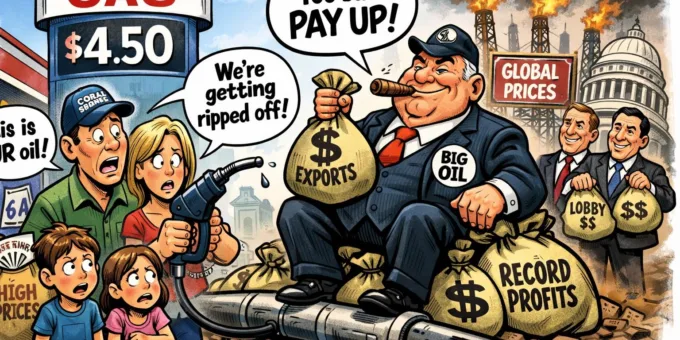
Why are Coral Springs citizens and families across the country paying inflated, crisis-driven prices while oil companies collect record profits?
And why aren’t our leaders stepping in to protect consumers from what increasingly looks like price gouging?
There are reasonable solutions:
- Tie domestic oil pricing more closely to production costs, allowing fair—but not excessive—profits
- Require companies that export American oil to share a portion of those profits back with U.S. citizens
- Work with key partners like Canada to stabilize North American energy pricing
- Treat energy as the strategic national asset it truly is
Because at the end of the day, this isn’t just about oil.
It’s about fairness.
It’s about whether families in Coral Springs—and millions of Americans like them—should have to stretch their budgets because of events they have no control over, while companies profit from resources that come from our own country.
And it’s about whether we’re willing to keep accepting it.
by Howard Melamed